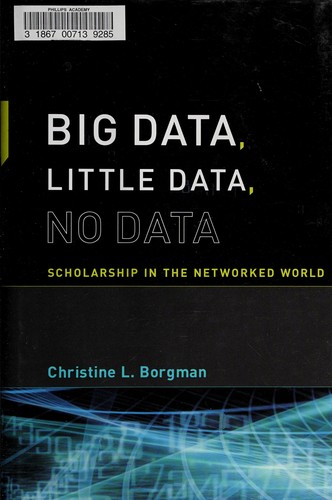
Big data, little data, no data
1.5 hrs read
Rate this book:
About This Book
"Big data" is on the covers of Science, Nature, the Economist, and Wired magazines, on the front pages of the Wall Street Journal and the New York Times. But despite the media hyperbole, as Christine Borgman points out in this examination of data and scholarly research, having the right data is usually better than having more data; little data can be just as valuable as big data. In many cases, there are no data - because relevant data don't exist, cannot be found, or are not available. Moreoever, data sharing is difficult, incentives to do so are minimal, and data practices vary widely across disciplines. Borgman, an often-cited authority on scholarly communication, argues that data have no value or meaning in isolation; they exist within a knowledge infrastructure - an ecology of people, practices, technologies, institutions, material objects, and relationships. After laying out the premises of her investigation - six "provocations" meant to inspire discussion about the uses of data in scholarship - Borgman offers case studies of data practices in the sciences, the social sciences, and the humanities, and then considers the implications of her findings for scholarly practice and research policy. To manage and exploit data over the long term, Borgman argues, requires massive investment in knowledge infrastructures; at stake is the future of scholarship. -- from dust jacket.
Buy This Book
As an Amazon Associate and Bookshop.org affiliate, BookOrb earns from qualifying purchases.
Write a Review
Sign in to write a review.
More by Christine L. Borgman

ASIS '88
Effective onlinesearching
Effective onlinesearching

From Gutenberg to the global information infrastructure
Research report prepared for O
Research report prepared for OCLC on end user behavior on the Ohio State University libraries' online catalog

Scholarly Communication and Bibliometrics
The user's mental model of an
The user's mental model of an information retrieval system