
On Our Own Ground
Rate this book:
About This Book
William Apess was the first Native American’s to fully, and publicly, speak out regarding the racism and unfair treatment that he and others endured. The author’s writing is eloquently delivered, instilling the reader with a realistic framework of a political, historical, and personal mindset.
On Our Own Ground, The Complete Writings of William Apess, a Pequot brings together all of the known writings of William Apess, a Native American of mixed Pequot and white parentage who fought for the United States in the War of 1812, became a Methodist minister in 1829, and championed the rights of the Mashpee tribe on Cape Cod in the 1830s. Apess's A Son of the Forest, originally published in 1829, was the first extended autobiography by an American Indian. Readable and engaging, it is not only a rare statement by a Native American, but also an unusually full document in the history of New England native peoples. Another piece in the collection, The Experiences of Five Christian Indians of the Pequo[d] Tribe (1833), concludes with an eloquent and unprecedented attack on Euro-American racism entitled "An Indian's Looking-Glass for the White Man." Also included are Apess's account of the "Mashpee Revolt" of 1833-34, when the Native Americans of Mashpee petitioned the government of Massachusetts for the right to elect their own representatives, and his Eulogy on King Philip, an address delivered in Boston in 1836 to mark the 160th anniversary of King Philip's War. In his extensive introduction to the volume, Barry O'Connell reconstructs the story of Apess's life, situates him in the context of early nineteenth-century Pequot society, and interprets his writings both as a literary act and as an expression of emerging Native American politics.
On Our Own Ground, The Complete Writings of William Apess, a Pequot brings together all of the known writings of William Apess, a Native American of mixed Pequot and white parentage who fought for the United States in the War of 1812, became a Methodist minister in 1829, and championed the rights of the Mashpee tribe on Cape Cod in the 1830s. Apess's A Son of the Forest, originally published in 1829, was the first extended autobiography by an American Indian. Readable and engaging, it is not only a rare statement by a Native American, but also an unusually full document in the history of New England native peoples. Another piece in the collection, The Experiences of Five Christian Indians of the Pequo[d] Tribe (1833), concludes with an eloquent and unprecedented attack on Euro-American racism entitled "An Indian's Looking-Glass for the White Man." Also included are Apess's account of the "Mashpee Revolt" of 1833-34, when the Native Americans of Mashpee petitioned the government of Massachusetts for the right to elect their own representatives, and his Eulogy on King Philip, an address delivered in Boston in 1836 to mark the 160th anniversary of King Philip's War. In his extensive introduction to the volume, Barry O'Connell reconstructs the story of Apess's life, situates him in the context of early nineteenth-century Pequot society, and interprets his writings both as a literary act and as an expression of emerging Native American politics.
Buy This Book
As an Amazon Associate and Bookshop.org affiliate, BookOrb earns from qualifying purchases.
Write a Review
Sign in to write a review.
More by William Apess

A son of the forest
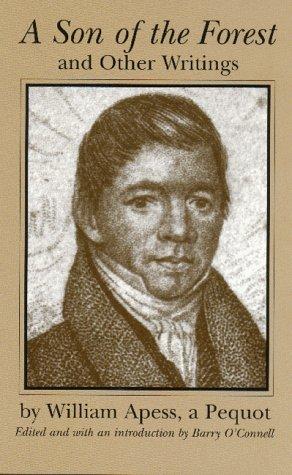
A son of the forest and other writings

A Son of the Forest the Experience of William Apes a Native of the Forest
Eulogy on King Philip, as pron
Eulogy on King Philip, as pronounced at the Odeon in Federal Street, Boston

Experience of five Christian Indians of the Pequod tribe
Experience of five Christian I
Experience of five Christian Indians, of the Pequad Tribe