
De pratica seu arte tripudii
1.1 hrs read
Rate this book:
About This Book
Fifteenth-century Italy produced the earliest known treatises on the dance. Guglielmo Ebreo, an eminent Jewish dancing master, dedicated his 'On the Practice or Art of Dancing' to the future Sforza duke of Milan in the determination to give dance the status enjoyed by music and other arts and sciences.
He included not only choreographies (subsequently likened to the artistic achievements of Machaut, Leonardo, Dante, and Petrarch), but a Defence of the Dance, a Socratic dialogue, and theoretical precepts - still valid today - which clearly reflect the contemporary humanistic aesthetic and ideals. Challenging exercises (such as dancing counter to the time of the music) and advice to young ladies at balls are also described.
Barbara Sparti has provided a heretofore unavailable source book for students, amateurs, and scholars: a critical edition in Italian and a facing English translation; dance tunes in facsimile and in annotated transcriptions based on the choreographies. Recent specialized studies and archival discoveries have greatly enriched the introductory chapters on De pratica's history, the interpretation of its music, Guglielmo's life, and dancing in fifteenth-century Italy.
An Appendix containing significant theoretical, musical, and choreographic additions from a later copy also has an Autobiography describing princely festivities, replete with names of participants, locations, and expenditures, of particular import to historians and those interested in court life in the Italian Renaissance.
A bibliography, biographical notes on Guglielmo's patrons, illustrations depicting scenes of dancing, as well as a glossary of dance, music, and humanistic terms, complete the critical apparatus.
He included not only choreographies (subsequently likened to the artistic achievements of Machaut, Leonardo, Dante, and Petrarch), but a Defence of the Dance, a Socratic dialogue, and theoretical precepts - still valid today - which clearly reflect the contemporary humanistic aesthetic and ideals. Challenging exercises (such as dancing counter to the time of the music) and advice to young ladies at balls are also described.
Barbara Sparti has provided a heretofore unavailable source book for students, amateurs, and scholars: a critical edition in Italian and a facing English translation; dance tunes in facsimile and in annotated transcriptions based on the choreographies. Recent specialized studies and archival discoveries have greatly enriched the introductory chapters on De pratica's history, the interpretation of its music, Guglielmo's life, and dancing in fifteenth-century Italy.
An Appendix containing significant theoretical, musical, and choreographic additions from a later copy also has an Autobiography describing princely festivities, replete with names of participants, locations, and expenditures, of particular import to historians and those interested in court life in the Italian Renaissance.
A bibliography, biographical notes on Guglielmo's patrons, illustrations depicting scenes of dancing, as well as a glossary of dance, music, and humanistic terms, complete the critical apparatus.
Buy This Book
As an Amazon Associate and Bookshop.org affiliate, BookOrb earns from qualifying purchases.
Write a Review
Sign in to write a review.
More by Guglielmo Ebreo da Pesaro
[Dance treatise by Guglielmo E
[Dance treatise by Guglielmo Ebreo da Pesaro ; 7 basse danze ; 3 sonetti ; Memorie]
Della virtute et arte del danz
Della virtute et arte del danzare et di alcune opportune et necessarie particelle a quella pertinenti
Otto basse danze
Otto basse danze
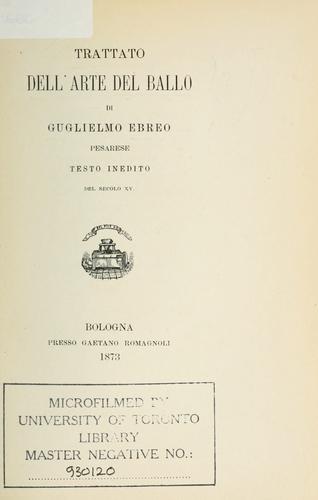
Trattato dell'arte del ballo
Tratto dell'arte del ballo
Tratto dell'arte del ballo