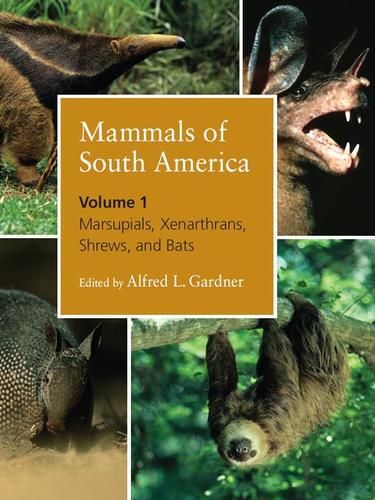
Mammals of South America, Volume 1
3.6 hrs read
Rate this book:
About This Book
The vast terrain between Panama and Tierra del Fuego contains some of the world’s richest mammalian fauna, but until now it has lacked a comprehensive systematic reference to the identification, distribution, and taxonomy of its mammals. The first such book of its kind and the inaugural volume in a three-part series, Mammals of South America both summarizes existing information and encourages further research of the mammals indigenous to the region.Containing identification keys and brief descriptions of each order, family, and genus, the first volume of Mammals of South America covers marsupials, shrews, armadillos, sloths, anteaters, and bats. Species accounts include taxonomic descriptions, synonymies, keys to identification, distributions with maps and a gazetteer of marginal localities, lists of recognized subspecies, brief summaries of natural history information, and discussions of issues related to taxonomic interpretations.Highly anticipated and much needed, this book will be a landmark contribution to mammalogy, zoology, tropical biology, and conservation biology.
Buy This Book
Amazon
Hardcover
→
Bookshop.org
Supports indie bookshops
→
Apple Books
Ebook
→
Open Library
Borrow
Free to borrow
→
As an Amazon Associate and Bookshop.org affiliate, BookOrb earns from qualifying purchases.
Write a Review
Sign in to write a review.
More by Alfred L. Gardner
A new species of Sturnira (Chi
A new species of Sturnira (Chiroptera: Phyllostomidae) from Peru
A new stenodermine bat (Phyllo
A new stenodermine bat (Phyllostomatidae) from Peru
A new subspecies of the Aztec
A new subspecies of the Aztec mastiff bat, Molossus aztecus Saussure, from southern Mexico

Checklist of vertebrates of the United States, the U.S. Territories, and Canada

Demography and natural history of the common fruit bat, Artibeus jamaicensis, on Barro Colorado Island, Panama
Karyotypic variation in oryzom
Karyotypic variation in oryzomyine rodents (Cricetinae) with comments on chromosomal evolution in neotropical cricetine complex