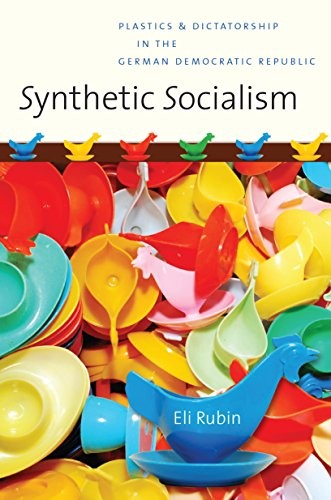
Synthetic socialism
1.2 hrs read
Rate this book:
About This Book
"Eli Rubin takes an innovative approach to consumer culture to explore questions of political consensus and consent and the impact of ideology on everyday life in the former East Germany. Synthetic Socialism explores the history of East Germany through the production and use of a deceptively simple material: plastic. Rubin investigates the connections between the communist government, its Bauhaus-influenced designers, its retooled postwar chemical industry, and its general consumer population. He argues that East Germany was neither a totalitarian state nor a niche society but rather a society shaped by the confluence of unique economic and political circumstances interacting with the concerns of ordinary citizens." "To East Germans, Rubin says, plastic was a high-technology material, a symbol of socialism's scientific and economic superiority over capitalism. Most of all, the state and its designers argued, plastic goods were of a particularly special quality, not to be thrown away like products of the wasteful West. Rubin demonstrates that this argument was accepted by the mainstream of East German society, for whom the modern, socialist dimension of a plastics-based everyday life had a deep resonance."--BOOK JACKET.
Buy This Book
As an Amazon Associate and Bookshop.org affiliate, BookOrb earns from qualifying purchases.
Write a Review
Sign in to write a review.
More by Eli Rubin
140 [i.e. one hundred forty] J
140 [i.e. one hundred forty] Jewish marshals, generals & admirals
140 Jewish marshalls, generals
140 Jewish marshalls, generals and admirals
700 years of Jewish life in Po
700 years of Jewish life in Poland
700 years of Jewish life in Po
700 years of Jewish life in Poland (His The Jews in the world)
Amnesiopolis Modernity, Space,
Amnesiopolis Modernity, Space, and Memory in East Germany
Ecologies of Socialisms
Ecologies of Socialisms