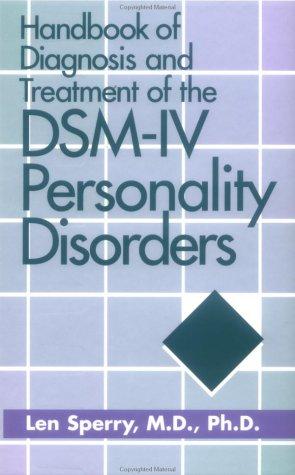
Handbook of diagnosis and treatment of the DSM-IV personality disorders
1 hr read
Rate this book:
About This Book
In recent years, the prognosis for clients with personality disorders has improved dramatically thanks to a tremendous increase in the development of specific skills for assessment and treatment. This is the only volume to offer a vast compendium of treatment modalities and approaches that have proven effective for the full range of personality disorders.
Current research indicates that a combination of formats is the preferred treatment for most individuals with personality disorders. Appropriately, the volume focuses on ways of combining and integrating treatment modalities and approaches: individual, group, marital and family modalities; and behavioral, cognitive, interpersonal, psychodynamic, and medication approaches.
The Handbook begins by addressing how and why personality disorders - once considered difficult if not impossible to treat - have been reconceptualized in a much broader fashion. This new paradigm shift reflects breakthroughs in assessment and combined treatment strategies of personality disorders, which coincide with the increasingly differentiated criteria of DSM-III, DSM-III-R, and now, DSM-IV. The volume goes on to examine eleven distinct types of personality disorders as designated by DSM-IV.
Each of these chapters is divided into five major sections: overview, description, clinical formulations, assessment, and treatment, with a major emphasis on the two latter categories.
Current research indicates that a combination of formats is the preferred treatment for most individuals with personality disorders. Appropriately, the volume focuses on ways of combining and integrating treatment modalities and approaches: individual, group, marital and family modalities; and behavioral, cognitive, interpersonal, psychodynamic, and medication approaches.
The Handbook begins by addressing how and why personality disorders - once considered difficult if not impossible to treat - have been reconceptualized in a much broader fashion. This new paradigm shift reflects breakthroughs in assessment and combined treatment strategies of personality disorders, which coincide with the increasingly differentiated criteria of DSM-III, DSM-III-R, and now, DSM-IV. The volume goes on to examine eleven distinct types of personality disorders as designated by DSM-IV.
Each of these chapters is divided into five major sections: overview, description, clinical formulations, assessment, and treatment, with a major emphasis on the two latter categories.
Buy This Book
As an Amazon Associate and Bookshop.org affiliate, BookOrb earns from qualifying purchases.
Write a Review
Sign in to write a review.


