
Greek forms of address
1.3 hrs read
Rate this book:
About This Book
How did an Athenian citizen address his wife? - his children, his slaves, and his dog? How did they address him? This book is the first major application of linguistic theories of address to an ancient language.
It is based on a corpus of 11,891 vocatives from twenty-five prose authors from Herodotus to Lucian, and on comparative data from Aristophanes, Menander, and other sources; the data are analysed using techniques and evidence from the field of sociolinguistics to shed light on some long-standing problems in Greek. A separate section discusses the theoretical problems which arise from the attempt to reconstruct conversational Greek on the basis of written texts and concludes that this enterprise is indeed possible, provided that the right sources are selected. Analysis of the Greek address system leads to a reconsideration of the meanings of individual addresses and thus of the interpretation of specific passages; it also challenges the validity of some alleged sociolinguistic 'universals'.
In particular, Eleanor Dickey examines some of the idiosyncratic aspects of Socrates' language, offering an exceptionally interesting and novel contribution to the problem of the 'historical Socrates'. Highly original, lucid, and jargon-free, this book offers many significant insights on both the literature and language of ancient Greece.
It is based on a corpus of 11,891 vocatives from twenty-five prose authors from Herodotus to Lucian, and on comparative data from Aristophanes, Menander, and other sources; the data are analysed using techniques and evidence from the field of sociolinguistics to shed light on some long-standing problems in Greek. A separate section discusses the theoretical problems which arise from the attempt to reconstruct conversational Greek on the basis of written texts and concludes that this enterprise is indeed possible, provided that the right sources are selected. Analysis of the Greek address system leads to a reconsideration of the meanings of individual addresses and thus of the interpretation of specific passages; it also challenges the validity of some alleged sociolinguistic 'universals'.
In particular, Eleanor Dickey examines some of the idiosyncratic aspects of Socrates' language, offering an exceptionally interesting and novel contribution to the problem of the 'historical Socrates'. Highly original, lucid, and jargon-free, this book offers many significant insights on both the literature and language of ancient Greece.
Buy This Book
As an Amazon Associate and Bookshop.org affiliate, BookOrb earns from qualifying purchases.
Write a Review
Sign in to write a review.
More by Eleanor Dickey

An Introduction to the Composition and Analysis of Greek Prose

Ancient Greek scholarship
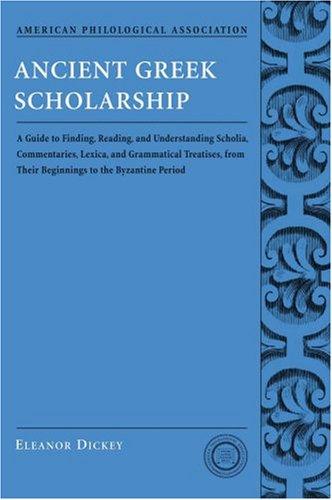
Ancient Greek Scholarship: A Guide to Finding, Reading, and Understanding Scholia, Commentaries, Lexica, and Grammatical Treatises
Colloquia of the Hermeneumata
Colloquia of the Hermeneumata Pseudodositheana
Colloquia of the Hermeneumata
Colloquia of the Hermeneumata Pseudodositheana 2 Volume Set
Colloquia of the Hermeneumata
Colloquia of the Hermeneumata Pseudodositheana Vol. 1