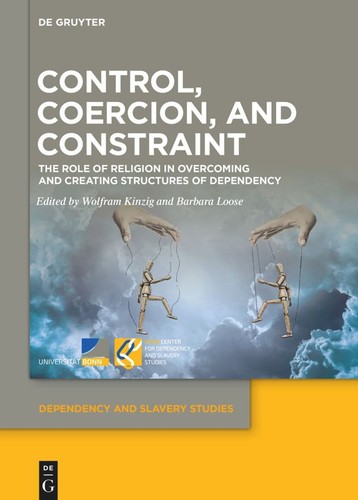
Control, Coercion, and Constraint
1.4 hrs read
Rate this book:
About This Book
from publisher: About this book Open Access
This volume is based on a lecture series that was held during the academic year 2021–2022 at the University of Bonn. Its contributors explore the role of religion in overcoming and creating structures of dependency from different disciplines and academic backgrounds.
The question of the role of religion in justifying, perpetuating, modifying, and abolishing slavery and other forms of strong asymmetrical dependency is still a much-debated topic within historical and social sciences. The equality of all human beings before God, gods, or the divine is deeply rooted in religious thought. Conversion to one or another religion has, therefore, often led to critique, transformation, and even abolition of existing social structures, institutions, and their corresponding dependencies.
Yet religious discourse has also been used to justify the subjection of individuals and whole peoples. In addition, throughout history, religious institutions themselves have often mirrored the social hierarchies and inequalities of the surrounding societies. Concomitantly, practitioners of these religious traditions have created systems of dependency within their own institutional, social, legal, and spiritual structures. This volume makes clear that not even the metaphysical world is free of dependencies: influential strands of almost all major religious traditions envisage hierarchies of gods, angels, demons, and other metaphysical beings.
Author / Editor information
Wolfram Kinzig and Barbara Loose, University of Bonn, Germany.
This volume is based on a lecture series that was held during the academic year 2021–2022 at the University of Bonn. Its contributors explore the role of religion in overcoming and creating structures of dependency from different disciplines and academic backgrounds.
The question of the role of religion in justifying, perpetuating, modifying, and abolishing slavery and other forms of strong asymmetrical dependency is still a much-debated topic within historical and social sciences. The equality of all human beings before God, gods, or the divine is deeply rooted in religious thought. Conversion to one or another religion has, therefore, often led to critique, transformation, and even abolition of existing social structures, institutions, and their corresponding dependencies.
Yet religious discourse has also been used to justify the subjection of individuals and whole peoples. In addition, throughout history, religious institutions themselves have often mirrored the social hierarchies and inequalities of the surrounding societies. Concomitantly, practitioners of these religious traditions have created systems of dependency within their own institutional, social, legal, and spiritual structures. This volume makes clear that not even the metaphysical world is free of dependencies: influential strands of almost all major religious traditions envisage hierarchies of gods, angels, demons, and other metaphysical beings.
Author / Editor information
Wolfram Kinzig and Barbara Loose, University of Bonn, Germany.
Buy This Book
As an Amazon Associate and Bookshop.org affiliate, BookOrb earns from qualifying purchases.
Write a Review
Sign in to write a review.
More by Wolfram Kinzig
"--zur Zeit oder Unzeit"
"--zur Zeit oder Unzeit"
"Gegen Julian"
"Gegen Julian"
Apostolische Glaubensbekenntni
Apostolische Glaubensbekenntnis
Christen und Nichtchristen in
Christen und Nichtchristen in Spätantike, Neuzeit und Gegenwart
Christenverfolgung in der Anti
Christenverfolgung in der Antike
Christian Persecution in Antiq
Christian Persecution in Antiquity