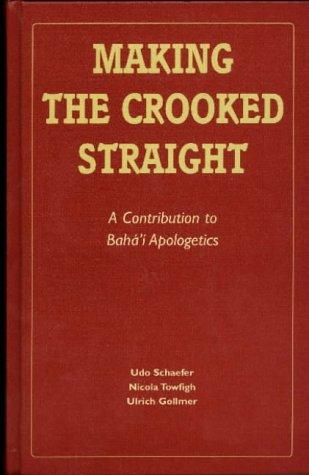
Making the Crooked Straight
3.4 hrs read
Rate this book:
About This Book
CONTENTS
<br>
<br>FOREWORD, by J.A. McLean xiii
<br>PREFACE TO THE GERMAN EDITION (1995) xxi
<br>PREFACE TO THE ENGLISH EDITION (2000) xxiii
<br>INTRODUCTION 1
<br>
<br>PART I: METHODOLOGY
<br>
<br>CHAPTER 1 OVERVIEW 15
<br>I. The limits of religious knowledge 15
<br>II. ‘Critical literature’ 18
<br>III. The renegade as researcher 27
<br>IV. The origins of the conflict 30
<br>
<br>CHAPTER 2 ON FICICCHIA’S METHODOLOGY 36
<br>I. Opportunism—the supreme principle of the Bahá’í Faith? 37
<br>II. Ficicchia’s standpoint 40
<br>III. Ficicchia’s portraits of the founding figures 56
<br>1. The Báb 56
<br>2. Bahá’u’lláh 58
<br>IV. Ficicchia’s portrait of ‘Abdu’l-Bahá 73
<br>V. The portrait of Shoghi Effendi 90
<br>VI. Ficicchia’s distorted image of the Bahá’í community 102
<br>VII. Ficicchia’s semantics 119
<br>VIII. The Bahá’ís—sectarian escapists and dangerous extremists?126
<br>1. On the charge of ‘unworldly isolation’ 126
<br>2. On the charge of subversion 135
<br>
<br>PART II: COMMUNITY AND DOCTRINE
<br>
<br>CHAPTER 3 FICICCHIA’S PORTRAIT OF THE COMMUNITY
<br>AND ITS ORDER 141
<br>I. The background: the Protestant concept of law 142
<br>II. Ficicchia’s critique of the order of the Bahá’í community and its foundations 149
<br>1. The Universal House of Justice — not foreseen by Bahá’u’lláh? 149
<br>2. ‘Abdu’l-Bahá’s testament—disputed? 152
<br>3. The Guardianship—a dictatorship? 154
<br>4. On the alleged ‘doctrinal legislation’ by the Universal House of Justice 158
<br>5. The community: a ‘steward of the grace’? 160
<br>6. Shoghi Effendi charged with having prevented the establishment of the Universal House of Justice 164
<br>7. On the subject of infallibility 166
<br>8. Freedom to teach—teaching authority 194
<br>9. Prepublication review—a censorship? 209
<br>10. Forbidden books? 213
<br>11. Freedom of expression prohibited? 214
<br>12. Criticism prohibited? 219
<br>13. Covenant-breaking and excommunication 224
<br>14. ‘Tricks’ and ‘the pressure of the plan’
<br>in missionary activities? 238
<br>15. ‘Complete renunciation of Christian beliefs’? 243
<br>16. The community—anti-democratic, centralist, secular? 245
<br>17. Ficicchia’s (mis)judgement of the Bahá’í community 254
<br>
<br>CHAPTER 4 FICICCHIA’S PRESENTATION OF BAHÁ’Í DOCTRINE 260
<br>I. On the concept of revelation 260
<br>II. On the station of Bahá’u’lláh 262
<br>III. On the Bahá’í doctrine of grace 267
<br>IV. On the Bahá’í concept of human nature 273
<br>V. On claims to absoluteness and exclusiveness 276
<br>VI. Emphatically rationalist, hostile to science, and esoteric, all at once? 289
<br>VII. On the concept of liberty 301
<br>
<br>CHAPTER 5 FICICCHIA’S PORTRAYAL OF BAHÁ’Í LAW 317
<br>I. The Law: A provocation 317
<br>II. Suppression and dissimulation of the Kitáb-i-Aqdas? 322
<br>III. Difficulties of publication 329
<br>1. Previous publications and translations 331
<br>2. On the Royal Asiatic Society’s English-language edition of 1961 334
<br>3. Problems of producing an authentic translation 337
<br>4. On the nature of divine legislation 338
<br>IV. Specific issues 352
<br>1. Taqíyya—a law of Bahá’u’lláh? 352
<br>2. The Kitáb-i-Aqdas—a sketchy ‘framework’? 362
<br>3. The sacred texts—falsified, interpolated? 369
<br>V. Some corrections regarding the content of particular laws 385
<br>1. On ritual daily prayer 385
<br>2. On the cut of the hair 390
<br>3. Bahá’í holy days and the Mashriqu’l-Adhkár 393
<br>VI. Corrections of other distortions 396
<br>1. On the dogmatic foundation of the law 396
<br>2. On the balance between justice and love 398
<br>3. A casuist system of ethics? 403
<br>4. A rigorous religious law? 409
<br>VII. On the nature of the law of God 411
<br>
<br>CHAPTER 6 BAHÁ’Í POLITICAL THOUGHT 418
<br>I. The Bahá’í community: authoritarian and antidemocratic? 420
<br>1. The Bahá’í Faith—‘political Mahdism’? 421
<br>2. A ‘claim to total power’ or fulfilment of
<br>eschatological prophecy? 424
<br>3. The need for peace 427
<br>4. A centralist global state? 432
<br>5. The eschatological realm of peace 435
<br>6. Claim to power or service to humanity? 440
<br>7. ‘Total possession taken of the individual’? 444
<br>II. Bahá’u’lláh—royalist and hostile to liberty? 446
<br>1. Bahá’u’lláh’s statements concerning kingship 448
<br>2. A power political alliance between church and state? 451
<br>3. Non-violent neutrality or partisanship? 453
<br>4. Universalism versus nationalism 454
<br>5. Justified ‘opposition’ or persecution of a non-violent religious minority? 457
<br>III. On the way to a new type of politics 464
<br>1. The concept of politics in Bahá’í scripture 465
<br>2. Loyalty to state authority 468
<br>3. Bahá’í elections: a non-partisan form of democratic appointment of government 470
<br>4. A new model for political decision-making 473
<br>5. Responsibility for the world we live in 476
<br>
<br>PART III: HISTORICAL ISSUES
<br>
<br>CHAPTER 7 PROBLEMS OF RESEARCH IN THE FIELD OF RELIGIOUS HISTORY 481
<br>
<br>CHAPTER 8 FICICCHIA’S SOURCES 492
<br>I. Kitáb-i-Nuqt.atu’l-Káf and Táríkh-i-Jadíd 496
<br>1. Kitáb-i-Nuqt.atu’l-Káf 500
<br>2. Táríkh-i-Jadíd 513
<br>II. Hasht Bihisht 522
<br>
<br>CHAPTER 9 FICICCHIA’S EUROPEAN SOURCES 529
<br>I. The orientalist Edward Granville Browne 529
<br>II. The Protestant minister Hermann Römer 546
<br>1. Römer’s presentation: its structure and influence on later works 551
<br>2. Römer’s portrayal of Bábí and Bahá’í history 554
<br>3. Römer’s interpretation of Bábí/Bahá’í doctrine 559
<br>
<br>CHAPTER 10 SOME ASPECTS OF BÁBÍ AND BAHÁ’Í HISTORY 571
<br>I. Mahdi claim and messianic secret 571
<br>1. Ficicchia’s sources 572
<br>2. The messianic secret 579
<br>3. The religious and political background 579
<br>4. The eschatological expectations of heterodox Shí‘a Islam 583
<br>5. The Báb’s claim 586
<br>II. Bahá’u’lláh’s claims 598
<br>1. The prophecy concerning the advent of Man yuz.hiruhu’lláh 601
<br>2. Two alleged proofs of the supremacy of Mírzá Yahyá in Baghdád 605
<br>3. On the dating of Bahá’u’lláh’s declaration 610
<br>III. Mírzá Yahyá Azal 618
<br>IV. Mírzá Yahyá as head of the Bábís and opponent of Bahá’u’lláh 631
<br>V. The cases of murder and attempted murder 650
<br>1. The murder of Dayyán 652
<br>2. The murder of three Azalís in ‘Akká 657
<br>3. The attempted murders committed by Mírzá Yahyá in Edirne 667
<br>VI. On the question of schism 671
<br>
<br>CHAPTER 11 THE WILL AND TESTAMENT OF ‘ABDU’L-BAHÁ 674
<br>I. The forgery theory 678
<br>II. The religious and historical background 680
<br>III. On the content of ‘Abdu’l-Bahá’s Will and Testament 687
<br>IV. The appointment of Shoghi Effendi as ‘Guardian of the Faith’—a historical overview 705
<br>V. The inventor of the forgery theory and her epigones 724
<br>VI. The arguments concerning style and content 735
<br>VII. The graphological assessment 744
<br>VIII. The ideological reasons for rejecting the Will and Testament 753
<br>IX. On the logical structure and stringency of the arguments 763
<br>X. Conclusion 774
<br>
<br>CONCLUSION 777
<br>
<br>APPENDIX 785
<br>
<br>BIBLIOGRAPHY 794
<br>
<br>INDEX OF NAMES 827
<br>
<br>GENERAL INDEX 836
<br>
<br>
<br>FOREWORD, by J.A. McLean xiii
<br>PREFACE TO THE GERMAN EDITION (1995) xxi
<br>PREFACE TO THE ENGLISH EDITION (2000) xxiii
<br>INTRODUCTION 1
<br>
<br>PART I: METHODOLOGY
<br>
<br>CHAPTER 1 OVERVIEW 15
<br>I. The limits of religious knowledge 15
<br>II. ‘Critical literature’ 18
<br>III. The renegade as researcher 27
<br>IV. The origins of the conflict 30
<br>
<br>CHAPTER 2 ON FICICCHIA’S METHODOLOGY 36
<br>I. Opportunism—the supreme principle of the Bahá’í Faith? 37
<br>II. Ficicchia’s standpoint 40
<br>III. Ficicchia’s portraits of the founding figures 56
<br>1. The Báb 56
<br>2. Bahá’u’lláh 58
<br>IV. Ficicchia’s portrait of ‘Abdu’l-Bahá 73
<br>V. The portrait of Shoghi Effendi 90
<br>VI. Ficicchia’s distorted image of the Bahá’í community 102
<br>VII. Ficicchia’s semantics 119
<br>VIII. The Bahá’ís—sectarian escapists and dangerous extremists?126
<br>1. On the charge of ‘unworldly isolation’ 126
<br>2. On the charge of subversion 135
<br>
<br>PART II: COMMUNITY AND DOCTRINE
<br>
<br>CHAPTER 3 FICICCHIA’S PORTRAIT OF THE COMMUNITY
<br>AND ITS ORDER 141
<br>I. The background: the Protestant concept of law 142
<br>II. Ficicchia’s critique of the order of the Bahá’í community and its foundations 149
<br>1. The Universal House of Justice — not foreseen by Bahá’u’lláh? 149
<br>2. ‘Abdu’l-Bahá’s testament—disputed? 152
<br>3. The Guardianship—a dictatorship? 154
<br>4. On the alleged ‘doctrinal legislation’ by the Universal House of Justice 158
<br>5. The community: a ‘steward of the grace’? 160
<br>6. Shoghi Effendi charged with having prevented the establishment of the Universal House of Justice 164
<br>7. On the subject of infallibility 166
<br>8. Freedom to teach—teaching authority 194
<br>9. Prepublication review—a censorship? 209
<br>10. Forbidden books? 213
<br>11. Freedom of expression prohibited? 214
<br>12. Criticism prohibited? 219
<br>13. Covenant-breaking and excommunication 224
<br>14. ‘Tricks’ and ‘the pressure of the plan’
<br>in missionary activities? 238
<br>15. ‘Complete renunciation of Christian beliefs’? 243
<br>16. The community—anti-democratic, centralist, secular? 245
<br>17. Ficicchia’s (mis)judgement of the Bahá’í community 254
<br>
<br>CHAPTER 4 FICICCHIA’S PRESENTATION OF BAHÁ’Í DOCTRINE 260
<br>I. On the concept of revelation 260
<br>II. On the station of Bahá’u’lláh 262
<br>III. On the Bahá’í doctrine of grace 267
<br>IV. On the Bahá’í concept of human nature 273
<br>V. On claims to absoluteness and exclusiveness 276
<br>VI. Emphatically rationalist, hostile to science, and esoteric, all at once? 289
<br>VII. On the concept of liberty 301
<br>
<br>CHAPTER 5 FICICCHIA’S PORTRAYAL OF BAHÁ’Í LAW 317
<br>I. The Law: A provocation 317
<br>II. Suppression and dissimulation of the Kitáb-i-Aqdas? 322
<br>III. Difficulties of publication 329
<br>1. Previous publications and translations 331
<br>2. On the Royal Asiatic Society’s English-language edition of 1961 334
<br>3. Problems of producing an authentic translation 337
<br>4. On the nature of divine legislation 338
<br>IV. Specific issues 352
<br>1. Taqíyya—a law of Bahá’u’lláh? 352
<br>2. The Kitáb-i-Aqdas—a sketchy ‘framework’? 362
<br>3. The sacred texts—falsified, interpolated? 369
<br>V. Some corrections regarding the content of particular laws 385
<br>1. On ritual daily prayer 385
<br>2. On the cut of the hair 390
<br>3. Bahá’í holy days and the Mashriqu’l-Adhkár 393
<br>VI. Corrections of other distortions 396
<br>1. On the dogmatic foundation of the law 396
<br>2. On the balance between justice and love 398
<br>3. A casuist system of ethics? 403
<br>4. A rigorous religious law? 409
<br>VII. On the nature of the law of God 411
<br>
<br>CHAPTER 6 BAHÁ’Í POLITICAL THOUGHT 418
<br>I. The Bahá’í community: authoritarian and antidemocratic? 420
<br>1. The Bahá’í Faith—‘political Mahdism’? 421
<br>2. A ‘claim to total power’ or fulfilment of
<br>eschatological prophecy? 424
<br>3. The need for peace 427
<br>4. A centralist global state? 432
<br>5. The eschatological realm of peace 435
<br>6. Claim to power or service to humanity? 440
<br>7. ‘Total possession taken of the individual’? 444
<br>II. Bahá’u’lláh—royalist and hostile to liberty? 446
<br>1. Bahá’u’lláh’s statements concerning kingship 448
<br>2. A power political alliance between church and state? 451
<br>3. Non-violent neutrality or partisanship? 453
<br>4. Universalism versus nationalism 454
<br>5. Justified ‘opposition’ or persecution of a non-violent religious minority? 457
<br>III. On the way to a new type of politics 464
<br>1. The concept of politics in Bahá’í scripture 465
<br>2. Loyalty to state authority 468
<br>3. Bahá’í elections: a non-partisan form of democratic appointment of government 470
<br>4. A new model for political decision-making 473
<br>5. Responsibility for the world we live in 476
<br>
<br>PART III: HISTORICAL ISSUES
<br>
<br>CHAPTER 7 PROBLEMS OF RESEARCH IN THE FIELD OF RELIGIOUS HISTORY 481
<br>
<br>CHAPTER 8 FICICCHIA’S SOURCES 492
<br>I. Kitáb-i-Nuqt.atu’l-Káf and Táríkh-i-Jadíd 496
<br>1. Kitáb-i-Nuqt.atu’l-Káf 500
<br>2. Táríkh-i-Jadíd 513
<br>II. Hasht Bihisht 522
<br>
<br>CHAPTER 9 FICICCHIA’S EUROPEAN SOURCES 529
<br>I. The orientalist Edward Granville Browne 529
<br>II. The Protestant minister Hermann Römer 546
<br>1. Römer’s presentation: its structure and influence on later works 551
<br>2. Römer’s portrayal of Bábí and Bahá’í history 554
<br>3. Römer’s interpretation of Bábí/Bahá’í doctrine 559
<br>
<br>CHAPTER 10 SOME ASPECTS OF BÁBÍ AND BAHÁ’Í HISTORY 571
<br>I. Mahdi claim and messianic secret 571
<br>1. Ficicchia’s sources 572
<br>2. The messianic secret 579
<br>3. The religious and political background 579
<br>4. The eschatological expectations of heterodox Shí‘a Islam 583
<br>5. The Báb’s claim 586
<br>II. Bahá’u’lláh’s claims 598
<br>1. The prophecy concerning the advent of Man yuz.hiruhu’lláh 601
<br>2. Two alleged proofs of the supremacy of Mírzá Yahyá in Baghdád 605
<br>3. On the dating of Bahá’u’lláh’s declaration 610
<br>III. Mírzá Yahyá Azal 618
<br>IV. Mírzá Yahyá as head of the Bábís and opponent of Bahá’u’lláh 631
<br>V. The cases of murder and attempted murder 650
<br>1. The murder of Dayyán 652
<br>2. The murder of three Azalís in ‘Akká 657
<br>3. The attempted murders committed by Mírzá Yahyá in Edirne 667
<br>VI. On the question of schism 671
<br>
<br>CHAPTER 11 THE WILL AND TESTAMENT OF ‘ABDU’L-BAHÁ 674
<br>I. The forgery theory 678
<br>II. The religious and historical background 680
<br>III. On the content of ‘Abdu’l-Bahá’s Will and Testament 687
<br>IV. The appointment of Shoghi Effendi as ‘Guardian of the Faith’—a historical overview 705
<br>V. The inventor of the forgery theory and her epigones 724
<br>VI. The arguments concerning style and content 735
<br>VII. The graphological assessment 744
<br>VIII. The ideological reasons for rejecting the Will and Testament 753
<br>IX. On the logical structure and stringency of the arguments 763
<br>X. Conclusion 774
<br>
<br>CONCLUSION 777
<br>
<br>APPENDIX 785
<br>
<br>BIBLIOGRAPHY 794
<br>
<br>INDEX OF NAMES 827
<br>
<br>GENERAL INDEX 836
<br>
Buy This Book
As an Amazon Associate and Bookshop.org affiliate, BookOrb earns from qualifying purchases.
Write a Review
Sign in to write a review.


