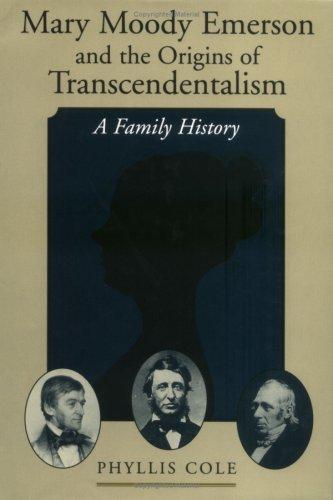
Mary Moody Emerson and the origins of transcendentalism
1.5 hrs read
Rate this book:
About This Book
Mary Moody Emerson has been cast by generations of scholars as the "eccentric aunt" of Ralph Waldo - a quickly, deeply religious woman who though the cherished epistolary partner of her nephew is herself worthy of no sustained critical attention. This biography suggests otherwise. This narrative rethinks both the extent of Mary's influence on her nephew and Mary's own historical standing as writer, thinker, spiritual seeker, and self-reliant, self-creating woman.
Biographer Phyllis Cole, who discovered Mary's "Almanack" in the Emerson family papers in 1981, introduces a self-taught, strikingly independent woman, a bold and philosophically gifted writer and fierce reader who chose solitude in nature over married life and other conventions.
Her thought and language honored and discretely assimilated by Waldo from youth through old age, Mary not only connected Waldo to a rich ancestral and cultural past but she also formed the matrix in which Waldo developed his essential philosophic and aesthetic themes.
It is through brilliant soul-making conversation between aunt and nephew, Cole demonstrates, rather than through typically cited sources such as Boston Unitarianism and English Romanticism, that Ralph Waldo Emerson's Miltonic mode of poetry and indeed his Transcendentalism took root and shape.
Sifting Mary's private and published writing, previously unexplored ancestral texts and family lore, new letters to Waldo in dialogue with his long-familiar letters to her, and major and minor Emersonian writings, Cole tells a captivating story of intellectual and spiritual enthusiasm within a distinctive family and culture, a story that begins with the zealous generations preceding Mary's own and concludes with her death in 1863 at the age of 88.
Cole's pioneering focus on a life Waldo deemed "purely original" unlocks a variety of new perspectives on late eighteenth- and nineteenth-century New England life and thought, and gives voice to a woman with much to say but from whom till now so little has been heard.
Biographer Phyllis Cole, who discovered Mary's "Almanack" in the Emerson family papers in 1981, introduces a self-taught, strikingly independent woman, a bold and philosophically gifted writer and fierce reader who chose solitude in nature over married life and other conventions.
Her thought and language honored and discretely assimilated by Waldo from youth through old age, Mary not only connected Waldo to a rich ancestral and cultural past but she also formed the matrix in which Waldo developed his essential philosophic and aesthetic themes.
It is through brilliant soul-making conversation between aunt and nephew, Cole demonstrates, rather than through typically cited sources such as Boston Unitarianism and English Romanticism, that Ralph Waldo Emerson's Miltonic mode of poetry and indeed his Transcendentalism took root and shape.
Sifting Mary's private and published writing, previously unexplored ancestral texts and family lore, new letters to Waldo in dialogue with his long-familiar letters to her, and major and minor Emersonian writings, Cole tells a captivating story of intellectual and spiritual enthusiasm within a distinctive family and culture, a story that begins with the zealous generations preceding Mary's own and concludes with her death in 1863 at the age of 88.
Cole's pioneering focus on a life Waldo deemed "purely original" unlocks a variety of new perspectives on late eighteenth- and nineteenth-century New England life and thought, and gives voice to a woman with much to say but from whom till now so little has been heard.
Buy This Book
As an Amazon Associate and Bookshop.org affiliate, BookOrb earns from qualifying purchases.
Write a Review
Sign in to write a review.
More by Phyllis Cole
Cross-Eyed Mailman
Cross-Eyed Mailman
Faith Challenge Bible Activity
Faith Challenge Bible Activity Book
Gender and race in American li
Gender and race in American literature
Resources for American Literar
Resources for American Literary Study, V.29
The do's and don'ts of DOS
The do's and don'ts of DOS
Toward a Female Genealogy of T
Toward a Female Genealogy of Transcendentalism