
The Five-Factor Model of Personality
54 min read
Rate this book:
About This Book
Since the 1980s, personality psychologists from a variety of perspectives have found the five-factor model to be an effective framework for identifying and structuring personality attributes. Measuring individual differences in terms of degrees of extraversion, agreeableness, conscientiousness, emotional stability, openness to experience, the model provides a common language for the field of personality psychology while at the same time supporting widely divergent approaches.
The volume opens with a historical overview of more than 60 years of research on the classification of personality traits. Subsequent chapters focus on theoretical questions that have guided the construction of the model, weigh the value and applicability of each of the five dimensions, and use the five-factor model as a point of departure for discussing broader issues concerning the development and dynamics of personality.
From the perspectives of the lexical approach, trait theory, interpersonal theory, socioanalytic theory, and evolutionary psychology, contributing authors explore such cogent issues as: the differences between the five-factor model and other multidimensional approaches to personality structure; whether the dimensions of the five-factor model are replicable across different cultures and languages; what the five-factor model adds to our understanding of human nature; the accuracy of self-reports, and descriptions of others, in trait measurement; and how each of the five factors comes into play in specific social contexts, such as mate attraction and coalition building.
The volume opens with a historical overview of more than 60 years of research on the classification of personality traits. Subsequent chapters focus on theoretical questions that have guided the construction of the model, weigh the value and applicability of each of the five dimensions, and use the five-factor model as a point of departure for discussing broader issues concerning the development and dynamics of personality.
From the perspectives of the lexical approach, trait theory, interpersonal theory, socioanalytic theory, and evolutionary psychology, contributing authors explore such cogent issues as: the differences between the five-factor model and other multidimensional approaches to personality structure; whether the dimensions of the five-factor model are replicable across different cultures and languages; what the five-factor model adds to our understanding of human nature; the accuracy of self-reports, and descriptions of others, in trait measurement; and how each of the five factors comes into play in specific social contexts, such as mate attraction and coalition building.
Buy This Book
As an Amazon Associate and Bookshop.org affiliate, BookOrb earns from qualifying purchases.
Write a Review
Sign in to write a review.
More by Jerry S. Wiggins
Interpersonal Adjectives Scale
Interpersonal Adjectives Scales Professional Manual

Paradigms of Personality Assessment
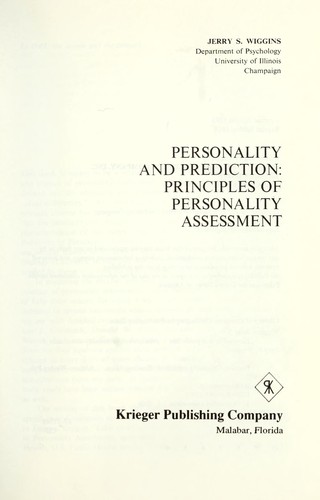
Personality and prediction
Personality and prediction: pr
Personality and prediction: principles of personality assessment

Psychology of Personality (Addison-Wesley Series in Psychology)
Substantive dimensions of self
Substantive dimensions of self-report in the MMPI item pool