
Elections in Japan, Korea, and Taiwan under the single non-transferable vote
1.9 hrs read
Rate this book:
About This Book
"In this volume, a distinguished group of scholars look at the impact of one electoral rule - the single non-transferable vote (SNTV) - on electoral competition in Japan, Korea, and Taiwan. Under the single non-transferable vote, each voter is allowed one vote although there is more than one seat to be filled."--BOOK JACKET.
"Through comparative studies of the adoption and rejection of SNTV and the consequences of its use in various settings, the contributors explore the differences in the operation and the effects of the application of one rule in three different countries.
Arguing that any single feature of a political system is embedded in a political structure and cannot be understood without studying its relationship with other parts of the political system, the authors demonstrate how the same rule can have different consequences depending on the context in which it operates."--BOOK JACKET.
"Through comparative studies of the adoption and rejection of SNTV and the consequences of its use in various settings, the contributors explore the differences in the operation and the effects of the application of one rule in three different countries.
Arguing that any single feature of a political system is embedded in a political structure and cannot be understood without studying its relationship with other parts of the political system, the authors demonstrate how the same rule can have different consequences depending on the context in which it operates."--BOOK JACKET.
Buy This Book
As an Amazon Associate and Bookshop.org affiliate, BookOrb earns from qualifying purchases.
Write a Review
Sign in to write a review.
More by Bernard Grofman

Behavioral social choice : probabilistic models, statistical inference, and applications
Computer-based research in the
Computer-based research in the social sciences

Controversies in Minority Voting

Different Democracy

Duverger's Law of Plurality Voting
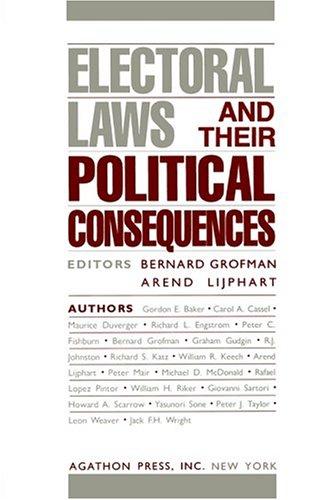
Electoral laws and their political consequences