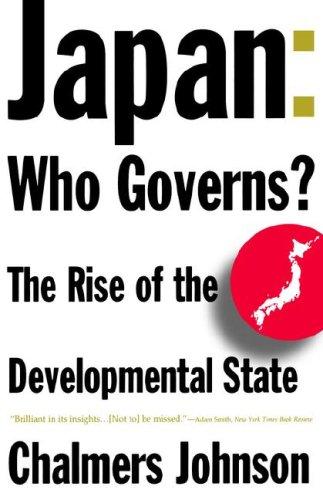
Japan: Who Governs?
1.6 hrs read
Rate this book:
About This Book
Japan's people have among the world's highest income - more than $28,000 yearly per capita. Even during a recession Japan is in the black. Its households save close to 20 percent of their disposable income. Japan's school system turns out a blue-collar work force possessing mathematical and reasoning skills that come only with a college degree in the United States.
Its pension and health-delivery systems, in contrast to most of the rest of the world, are efficient and relatively inexpensive, its unemployment rate half that of the United States and Germany. And its high-tech industries are not saddled with having to convert, expensively, from military to commercial purposes.
. How did this happen? If the Cold War is over, did Japan actually win it, while the two major protagonists merely exhausted themselves? The answers lie, according to Chalmers Johnson, one of our wisest and most provocative scholars, in Japan's remarkable, much-misunderstood and maligned "capitalist developmental state," a term he coined to describe Japan and other East Asian economies now following in its footsteps.
Japan's economic system is one in which public service is highly valued; state bureaucracy attracts the best, young minds; and "economic guidance" by the state is both accepted and ubiquitous. As explained here with rare lucidity and historical depth, Japan's economy is not likely to falter. Instead, Johnson sees it continuing to thrive as it moves from a producer-dominated economy to a consumer-oriented headquarters for all of East Asia.
Johnson also explores the history of Japan's postwar political development, and policies both at home and abroad.
Its pension and health-delivery systems, in contrast to most of the rest of the world, are efficient and relatively inexpensive, its unemployment rate half that of the United States and Germany. And its high-tech industries are not saddled with having to convert, expensively, from military to commercial purposes.
. How did this happen? If the Cold War is over, did Japan actually win it, while the two major protagonists merely exhausted themselves? The answers lie, according to Chalmers Johnson, one of our wisest and most provocative scholars, in Japan's remarkable, much-misunderstood and maligned "capitalist developmental state," a term he coined to describe Japan and other East Asian economies now following in its footsteps.
Japan's economic system is one in which public service is highly valued; state bureaucracy attracts the best, young minds; and "economic guidance" by the state is both accepted and ubiquitous. As explained here with rare lucidity and historical depth, Japan's economy is not likely to falter. Instead, Johnson sees it continuing to thrive as it moves from a producer-dominated economy to a consumer-oriented headquarters for all of East Asia.
Johnson also explores the history of Japan's postwar political development, and policies both at home and abroad.
Buy This Book
As an Amazon Associate and Bookshop.org affiliate, BookOrb earns from qualifying purchases.
Write a Review
Sign in to write a review.


