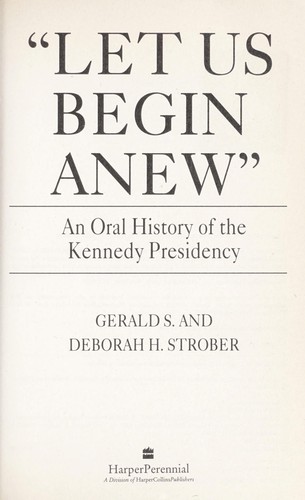
Let us begin anew
2.2 hrs read
Rate this book:
About This Book
"Let Us Begin Anew" is a startlingly vivid inside look at what it was like to be a member or a close witness - friendly or hostile - of the Kennedy administration. The nearly 120 people interviewed for this book, speaking informally and from the less-pressured perspective of thirty years later, include men and women who worked for the president or observed him as insiders, from his decision to run for the Democratic nomination in 1960 through the aftermath of the.
Assassination in 1963. Their recollections and anecdotes bring personal insights, humor, and emotion to the many topics discussed. Among these topics are the "Kennedy style"; the question of how much influence Kennedy's father and brother Bobby had over the president; important incidents during the 1960 primary and election campaigns, such as JFK's meeting with the Southern Baptist ministers to confront the Catholic issue; and the controversial decision to choose LBJ as.
The vice presidential candidate, which still stuns and dismays many - but not all - of JFK's supporters. Foreign affairs are also covered, including how JFK and his advisers handled and mishandled the Bay of Pigs disaster - the unsuccessful attempt by an American-supported invasion of Cuban exiles to provoke the overthrow of Castro; the expectations and disappointments of the first summit meeting with Khrushchev in Vienna; behind the scenes in the Oval Office during the.
Cuban missile crisis - the serious confrontation that took the United States and the Soviet Union to the brink of war; and the issue of Vietnam, the administration's role in the assassination of President Ngo Dinh Diem, and speculation about what Kennedy would have done if he had lived - expanded our involvement as LBJ did, or pulled back. On the domestic front, there are in-depth examinations of the administration's support for the space program; White House relations.
With J. Edgar Hoover of the FBI; and the administration's handling of the growing civil rights issue - their initial ignorance of the problem and lack of contact with black activists and blacks in general, and how that changed, as recalled by blacks and whites who were involved. The contributors to "Let Us Begin Anew" include cabinet members; foreign statesmen; senators; congressmen; military leaders; ambassadors; many lower-level officials; journalists such as Tom.
Wicker and Ben Bradlee; Kennedy's loyal Boston aides; Harvard intellectuals; politicians such as George McGovern, George Wallace, and Gerald Ford; and many more. The result is a fascinating insight into a fascinating period - at times funny, dramatic, and moving - and an important contribution to our knowledge of this era.
Assassination in 1963. Their recollections and anecdotes bring personal insights, humor, and emotion to the many topics discussed. Among these topics are the "Kennedy style"; the question of how much influence Kennedy's father and brother Bobby had over the president; important incidents during the 1960 primary and election campaigns, such as JFK's meeting with the Southern Baptist ministers to confront the Catholic issue; and the controversial decision to choose LBJ as.
The vice presidential candidate, which still stuns and dismays many - but not all - of JFK's supporters. Foreign affairs are also covered, including how JFK and his advisers handled and mishandled the Bay of Pigs disaster - the unsuccessful attempt by an American-supported invasion of Cuban exiles to provoke the overthrow of Castro; the expectations and disappointments of the first summit meeting with Khrushchev in Vienna; behind the scenes in the Oval Office during the.
Cuban missile crisis - the serious confrontation that took the United States and the Soviet Union to the brink of war; and the issue of Vietnam, the administration's role in the assassination of President Ngo Dinh Diem, and speculation about what Kennedy would have done if he had lived - expanded our involvement as LBJ did, or pulled back. On the domestic front, there are in-depth examinations of the administration's support for the space program; White House relations.
With J. Edgar Hoover of the FBI; and the administration's handling of the growing civil rights issue - their initial ignorance of the problem and lack of contact with black activists and blacks in general, and how that changed, as recalled by blacks and whites who were involved. The contributors to "Let Us Begin Anew" include cabinet members; foreign statesmen; senators; congressmen; military leaders; ambassadors; many lower-level officials; journalists such as Tom.
Wicker and Ben Bradlee; Kennedy's loyal Boston aides; Harvard intellectuals; politicians such as George McGovern, George Wallace, and Gerald Ford; and many more. The result is a fascinating insight into a fascinating period - at times funny, dramatic, and moving - and an important contribution to our knowledge of this era.
Buy This Book
As an Amazon Associate and Bookshop.org affiliate, BookOrb earns from qualifying purchases.
Write a Review
Sign in to write a review.


