
Raymond Edward Brown
b. 1928 – d. 1998 · 33 books
Biography
Raymond Edward Brown SS was an American Catholic priest, a member of the Sulpician Fathers and a prominent biblical scholar. He was regarded as a specialist concerning the hypothetical "Johannine community", which he speculated contributed to the authorship of the Gospel of John, and he also wrote influential studies on the birth and death of Jesus. Brown was professor emeritus at Union Theological Seminary (UTS) in New York where he taught for 29 years. He was the first Catholic professor to gain tenure there, where he earned a reputation as a superior lecturer.
Brown was one of the first Catholic scholars to apply historical-critical analysis to the Bible. As biblical criticism developed in the 19th century, the Catholic Church opposed this scholarship and essentially forbade it in 1893. In 1943, however, the Church issued the papal encyclical Divino Afflante Spiritu, which authorised Catholic scholars to investigate the Bible historically. Brown called this encyclical the "Magna Carta of biblical progress." The Second Vatican Council (Vatican II) further supported the method of higher criticism, which, Brown felt, vindicated his approach.
Brown remains controversial among traditionalist Catholics because of their claim that he denied the inerrancy of the whole of scripture and cast doubt on the historical accuracy of numerous articles of the Catholic faith. Some conservatives were angered at his questioning of whether the virginal conception of Jesus could be proven historically. He was regarded as occupying the center ground in the field of biblical studies, opposing the literalism found among many fundamentalist Christians while not carrying his conclusions as far as many other scholars.
Brown was one of the first Catholic scholars to apply historical-critical analysis to the Bible. As biblical criticism developed in the 19th century, the Catholic Church opposed this scholarship and essentially forbade it in 1893. In 1943, however, the Church issued the papal encyclical Divino Afflante Spiritu, which authorised Catholic scholars to investigate the Bible historically. Brown called this encyclical the "Magna Carta of biblical progress." The Second Vatican Council (Vatican II) further supported the method of higher criticism, which, Brown felt, vindicated his approach.
Brown remains controversial among traditionalist Catholics because of their claim that he denied the inerrancy of the whole of scripture and cast doubt on the historical accuracy of numerous articles of the Catholic faith. Some conservatives were angered at his questioning of whether the virginal conception of Jesus could be proven historically. He was regarded as occupying the center ground in the field of biblical studies, opposing the literalism found among many fundamentalist Christians while not carrying his conclusions as far as many other scholars.
Books by Raymond Edward Brown

Novo comentário bíblico São Jerônimo Antigo Testamento

An introduction to the Gospel of John
Raymond E. Brown Boxed Set
Raymond E. Brown Boxed Set

A retreat with John the Evangelist

Christ in the Gospels of the ordinary Sundays

A once-and-coming Spirit at Pentecost
Introduction to New Testament
Introduction to New Testament Christology

The death of the Messiah

A risen Christ in Eastertime

Responses to 101 questions on the Bible

Schriftauslegung im Widerstreit

A coming Christ in Advent

A crucified Christ in Holy Week

Recent Discoveries & the Biblical World

Antioch and Rome

La communauté du disciple bien-aimé
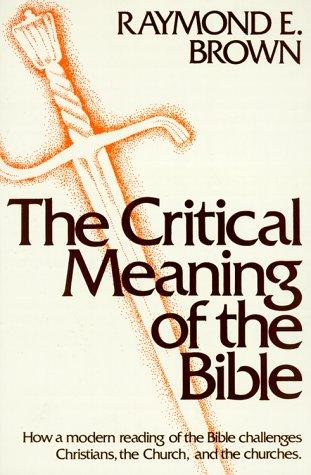
The critical meaning of the Bible

An adult Christ at Christmas

The birth of the Messiah

Der Petrus der Bibel

Biblical reflections on crises facing the church
Biblical reflections on crisis facing the Church
Refining molten iron by sulfid
Refining molten iron by sulfide-forming slags and chlorination

The virginal conception and bodily resurrection of Jesus

Priest and bishop

The Gospel According to John XIII-XXI (Anchor Bible, Vol 29, Part A)

Biblical tendencies today
The Jerome Bibical commentary
The Jerome Bibical commentary
The Semitic background of the
The Semitic background of the term "mystery" in the New Testament

Jesus : God and man
The Gospel of St. John and the
The Gospel of St. John and the Johannine Epistles
Parable and allegory reconside
Parable and allegory reconsidered

The Sensus plenior of sacred scripture