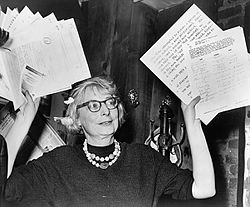
Jane Jacobs
b. 1916 – d. 2006 · 23 books
Biography
Jane Jacobs (born Jane Butzner; May 4, 1916 – April 25, 2006) was a Canadian and American journalist, author, and activist best known for her influence on urban studies. Her influential book *The Death and Life of Great American Cities* (1961) argued that urban renewal did not respect the needs of most city-dwellers. The book also introduced sociology concepts such as "eyes on the street" and "social capital".
Jacobs was well known for organizing grassroots efforts to protect existing neighborhoods from "slum clearance" – and particularly for her opposition to Robert Moses in his plans to overhaul her neighborhood, Greenwich Village. She was instrumental in the eventual cancellation of the Lower Manhattan Expressway, which would have passed directly through SoHo and Little Italy, and was arrested in 1968 for inciting a crowd at a public hearing on the project. After moving to Toronto in 1968, she joined the opposition to the Spadina Expressway and the associated network of expressways in Toronto planned and under construction.
As a mother and a female writer who criticized experts in the male-dominated field of urban planning, Jacobs endured scorn from established figures, who called her a "housewife" and a "crazy dame." She did not have a college degree, or any formal training in urban planning, and was criticized for being unscholarly and imprecise. She was also accused of inattention to racial inequality, and her concept of "unslumming" has been compared with gentrification.
<u>Source</u>: Jane Jacobs. (2016, May 4). In *Wikipedia, The Free Encyclopedia*. Retrieved 10:55, May 4, 2016, from `https://en.wikipedia.org/w/index.php?title=Jane_Jacobs&oldid=718578863`
Jacobs was well known for organizing grassroots efforts to protect existing neighborhoods from "slum clearance" – and particularly for her opposition to Robert Moses in his plans to overhaul her neighborhood, Greenwich Village. She was instrumental in the eventual cancellation of the Lower Manhattan Expressway, which would have passed directly through SoHo and Little Italy, and was arrested in 1968 for inciting a crowd at a public hearing on the project. After moving to Toronto in 1968, she joined the opposition to the Spadina Expressway and the associated network of expressways in Toronto planned and under construction.
As a mother and a female writer who criticized experts in the male-dominated field of urban planning, Jacobs endured scorn from established figures, who called her a "housewife" and a "crazy dame." She did not have a college degree, or any formal training in urban planning, and was criticized for being unscholarly and imprecise. She was also accused of inattention to racial inequality, and her concept of "unslumming" has been compared with gentrification.
<u>Source</u>: Jane Jacobs. (2016, May 4). In *Wikipedia, The Free Encyclopedia*. Retrieved 10:55, May 4, 2016, from `https://en.wikipedia.org/w/index.php?title=Jane_Jacobs&oldid=718578863`
Books by Jane Jacobs
Architecture and Geography
Architecture and Geography

Cuatro entrevistas
Sebastian Yatra Adult Coloring
Sebastian Yatra Adult Coloring Book

Buildings Must Die

SAP Certified Application Associate - SAP Hybris Cloud for Service

SAP Certified Integration Associate - SAP Cloud for Customer

Vital Little Plans

Question of Separatism

Dark age ahead

The nature of economies

Cities of difference

A School Teacher In Old Alaska
Systems of survival
Girl on the Hat
Girl on the Hat

Cities and the wealth of nations

The Question of Separatism

Canadian cities and sovereignty association
Understanding low income famil
Understanding low income families

The economy of cities
The Death and Life of Great American Cities
Tod und Leben grosser amerikan
Tod und Leben grosser amerikanischer Städte
Reprints of three reviews of T
Reprints of three reviews of The Death and Life of Great American Cities, by Jane Jacobs, Random House. 1961
Systemes de survie (French Edi
Systemes de survie (French Edition)