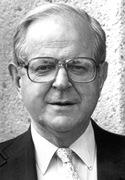
Robert Conquest
b. 1917 – d. 2015 · 33 books
Biography
Robert Conquest was born in Malvern, Worcestershire, the son of an American businessman and a Norwegian mother. He was educated at Winchester College, the University of Grenoble, Oxford University, where he was an exhibitioner in modern history and took his bachelor's and master's degrees in Philosophy, Politics and Economics, and his doctorate in Soviet history. In 1937, after a year studying at the University of Grenoble and traveling in Bulgaria, he returned to Oxford and joined the Communist Party. When When World War II began, he became an intelligence officer in the Light Infantry. In 1940, he married Joan Watkins, with whom he had two sons. In 1944, while posted to Bulgaria as a liaison officer to the Bulgarian forces fighting under Soviet command, he met Tatiana Mihailova, who later became his second wife. After the war, he became the press officer at the British embassy in Sofia, Bulgaria, where he witnessed the gradual rise of Soviet communism in the country, and he became disillusioned with communism. He returned to London, helping Tatiana escape at the same time, divorced his first wife and married Tatiana.
He joined a branch of the Foreign Office, then left in 1956 to become a freelance writer and historian. His first books, Power and Politics in the USSR and Soviet Deportation of Nationalities, were published in 1960. In addition to historical works, he also published science fiction. In 1962, he was divorced from his second wife and in 1964 he married again, but this marriage was dissolved in 1978 and in 1979 he married his fourth wife. In 1981, he moved to California where he is currently a Research Fellow at the Hoover Institution at Stanford University.
Conquest is now senior research fellow and scholar-curator of the Russian and Commonwealth of Independent States Collection at the Hoover Institution. He is also an adjunct fellow of the Center for Strategic and International Studies in Washington, D.C., and a former research associate of Harvard University's Ukrainian Research Institute. He is a member of the board of the Institute for European Defence and Strategic Studies. He is a fellow of the British Interplanetary Society and a member of the Society for the Promotion of Roman Studies and the American Association for the Advancement of Slavic Studies.
He joined a branch of the Foreign Office, then left in 1956 to become a freelance writer and historian. His first books, Power and Politics in the USSR and Soviet Deportation of Nationalities, were published in 1960. In addition to historical works, he also published science fiction. In 1962, he was divorced from his second wife and in 1964 he married again, but this marriage was dissolved in 1978 and in 1979 he married his fourth wife. In 1981, he moved to California where he is currently a Research Fellow at the Hoover Institution at Stanford University.
Conquest is now senior research fellow and scholar-curator of the Russian and Commonwealth of Independent States Collection at the Hoover Institution. He is also an adjunct fellow of the Center for Strategic and International Studies in Washington, D.C., and a former research associate of Harvard University's Ukrainian Research Institute. He is a member of the board of the Institute for European Defence and Strategic Studies. He is a fellow of the British Interplanetary Society and a member of the Society for the Promotion of Roman Studies and the American Association for the Advancement of Slavic Studies.
Books by Robert Conquest

Blokelore and Blokesongs
Dragons of Expectation
Dragons of Expectation

Flawed Succession
The Gulag collection
The Gulag collection

History, humanity, and truth

Stalin and the Kirov murder

Tyrants and Typewriters
Kampʹhā-yi marg-i Kūlīmā
Kampʹhā-yi marg-i Kūlīmā

The harvest of sorrow

The Man-made famine in Ukraine
We & they
We & they
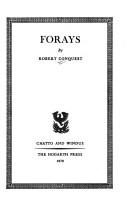
Forays

The abomination of Moab

Spectrum : No. 1
The great terror; Stalin's pur
The great terror; Stalin's purge of the thirties
Arias from a love opera, and o
Arias from a love opera, and other poems
The human cost of Soviet commu
The human cost of Soviet communism
The nation killers
The nation killers

Where Marx went wrong
Arias from a love opera
Arias from a love opera

Agricultural workers in the U.S.S.R

The great terror

Industrial workers in the U.S.S.R.

Soviet nationalities policy in practice

The politics of ideas in the U.S.S.R

Russia after Khrushchev
Marxism to-day
Marxism to-day
New lines-II
New lines-II
Between Mars and Venus
Between Mars and Venus

The Last Empire
The Pasternak affair
The Pasternak affair
Where do Marxists go from here
Where do Marxists go from here?
Great Terror, the
Great Terror, the