There are 14 books by Stanley L. Brodsky on BookOrb. A strong starting point is Therapy with coerced and reluctant clients (2011). The bibliography below is in publication order, with series grouped in reading order.
Standalone books




Showing 13 of 14 titles.
Frequently asked questions
How many books has Stanley L. Brodsky written?
BookOrb lists 14 books by Stanley L. Brodsky.
Where should I start with Stanley L. Brodsky?
A good starting point is Therapy with coerced and reluctant clients (2011).
What is the Stanley L. Brodsky books in order list?
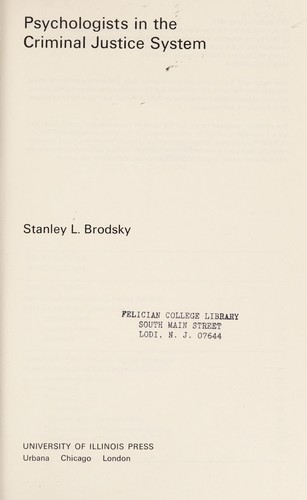
In publication order: 1. Language patterns of repressors and sensitizers in personal and impersonal descriptions (1964), 2. The Military Prison: Theory, Research, and Practice (1970), 3. Psychologists in the criminal justice system (1972), 4. PSYCHOLOGISTS IN CRIM JUSTICE (1973), 5. Families and friends of men in prison (1975), 6. Psy-fi one (1977), 7. Client participation in human services (1978), 8. Handbook of scales for research in crime and delinquency (1983), 9. The psychology of adjustment and well-being (1988), 10. Thep sychology of adjustment and well-being (1988), 11. The expert expert witness (1999), 12. Coping with cross-examination and other pathways to effective testimony (2004), 13. Therapy with coerced and reluctant clients (2011).