
Sir William F. Barrett
b. 1844 – d. 1925 · 22 books
Biography
William Fletcher Barrett was born in Jamaica where his father, William Garland Barrett, a member of the London Missionary Society, ministered to emancipated African slaves. In 1848, he returned with his family to Royston, England. In 1855 they moved to Manchester, and he attended Old Trafford Grammar School.
Barrett then studied chemistry and physics at the Royal College of Chemistry in London. In 1867 he became the science master at the International College, London, then assistant to John Tyndall at the Royal Institution. He then taught at the Royal School of Naval Architecture, and in 1873 he became Professor of Experimental Physics at the Royal College of Science for Ireland. His mother and sister lived with him in Kingstown (now Dún Laoghaire).
Barrett studied metal and their properties, and discovered Stalloy, a silicon-iron alloy used in electrical engineering. He also discovered the shortening of nickel through magnetization in 1882.
In the 1860s Barrett became interested in the paranormal, and he began investigating poltergeists and thought transference. In 1876 he published several papers as a result of these investigations, which were controversial. In 1882 he founded the Society for Psychical Research. In 1884 he had moved to the United States, where he founded the American Society of Psychical Research. By 1908 he was active in the Dublin Section of the Society for Psychical Research. In 1916 he married Dr. Florence Willey. In 1919 he wrote the introduction to medium Hester Dowden's book *Voices from the Void*.
In 1899 Barrett was elected a Fellow of the Royal Society. He was also a fellow of the Royal Society of Edinburgh and the Royal Dublin Society. He was knighted in 1912.
Barrett then studied chemistry and physics at the Royal College of Chemistry in London. In 1867 he became the science master at the International College, London, then assistant to John Tyndall at the Royal Institution. He then taught at the Royal School of Naval Architecture, and in 1873 he became Professor of Experimental Physics at the Royal College of Science for Ireland. His mother and sister lived with him in Kingstown (now Dún Laoghaire).
Barrett studied metal and their properties, and discovered Stalloy, a silicon-iron alloy used in electrical engineering. He also discovered the shortening of nickel through magnetization in 1882.
In the 1860s Barrett became interested in the paranormal, and he began investigating poltergeists and thought transference. In 1876 he published several papers as a result of these investigations, which were controversial. In 1882 he founded the Society for Psychical Research. In 1884 he had moved to the United States, where he founded the American Society of Psychical Research. By 1908 he was active in the Dublin Section of the Society for Psychical Research. In 1916 he married Dr. Florence Willey. In 1919 he wrote the introduction to medium Hester Dowden's book *Voices from the Void*.
In 1899 Barrett was elected a Fellow of the Royal Society. He was also a fellow of the Royal Society of Edinburgh and the Royal Dublin Society. He was knighted in 1912.
Books by Sir William F. Barrett

Telepathy And Its Implications - Pamphlet

The Lesson Of Philosophy In The Interpretation Of Nature

The Physical Phenomenon Of Spiritualism - Pamphlet

The Willing Game And So-Called Thought Reading - Pamphlet

Automatic Writing And Cross Correspondence

Dreams And Crystal Visions

Evidence Of Survival After Death

Experimental And Spontaneous Telepathy Over Long Distances

Mesmerism, Hypnotism And Suggestion

Psychical Research And The Threshold Of The Unseen

Supernormal Perception

The Physical Phenomena Of Spiritualism

The So-Called Divining Or Dowsing Rod

The Subliminal Self

Thought Transference And The Hypnotic State

Thought Transference In The Normal State Of The Percipient

Visual Hallucinations And Phantasms Of The Living And Dead

Psychical research

The Religion of Health
Seeing Without Eyes
Seeing Without Eyes
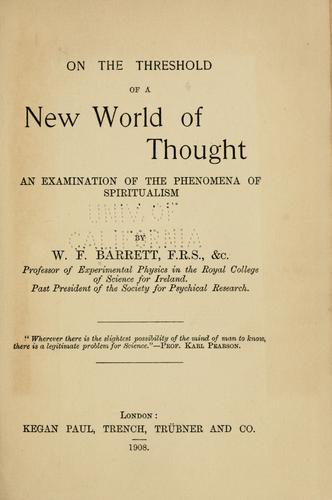
On the threshold of a new world of thought
Notes of Ten Evening Lectures
Notes of Ten Evening Lectures on Heat